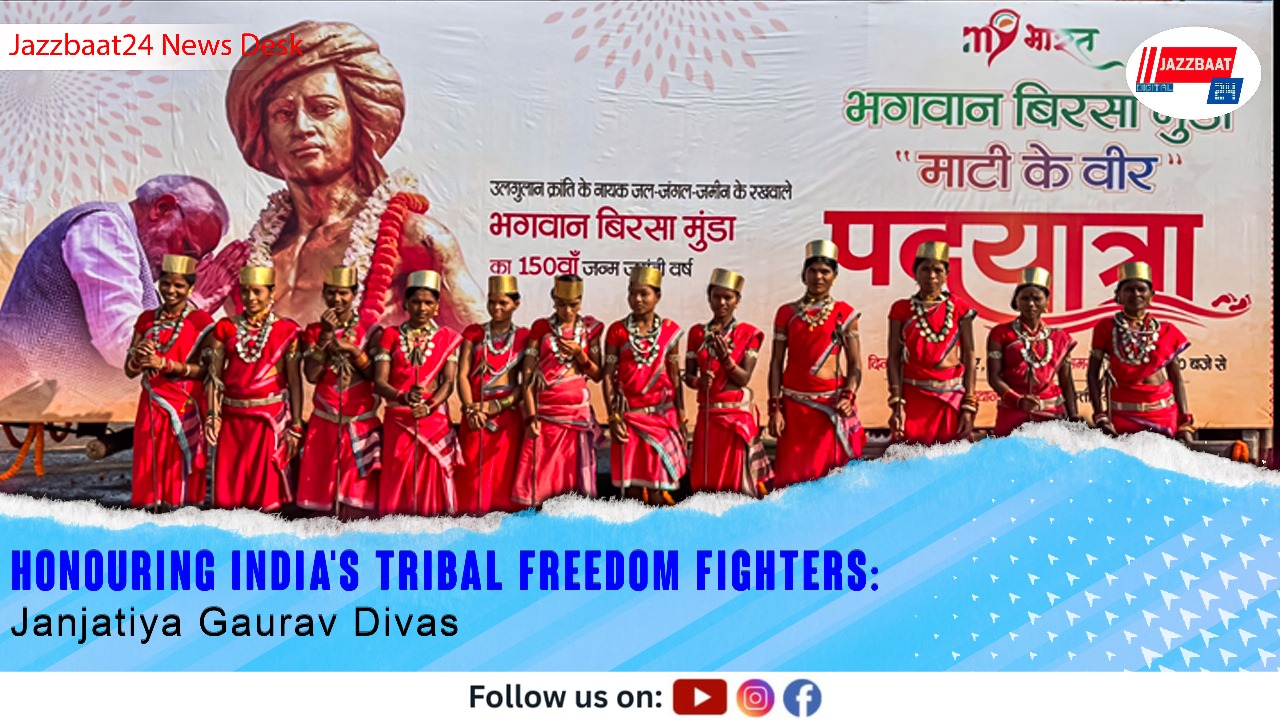
November 15th is the day of tribal pride, Janjatiya Gaurav Divas, a day in memory and legacy of tribal freedom fighters in India, and more specifically the life of one of the most legendary leaders, Birsa Munda, the champion against the British colonialism and feudalism in India. This time the country is united to celebrate the important yet little remembered roles played by tribal groups in the independence movement of India. It is not only a day to remember the historical personalities of such people as Birsa Munda, but also a day to appreciate the rich and diverse cultural heritage of the tribal people of India.
Birsa Munda was a progressive leader who, at the age of 1874, moved the people of an area now known as Jharkhand, to rise up against British colonial policies and land tenure systems that were oppressive to the people. His life and sacrifices have been a source of inspiration to many generations and his memory is instilled in several forms in India one of them being in the Tribal Freedom Fighters Museums. These museums are meant to conserve the history of the tribal movements that played a key role in the struggle against the colonial rule but, regrettably, they have not been given the recognition they deserve in the mainstream Indian history.
The Ministry of Tribal Affairs through the Government of India is also engaged in a strong program to pay tribute to tribal freedom fighters and the current Janjatiya Gaurav Varsh is one of the events that commemorates the 150 th birth anniversary of Birsa Munda. The whole country has seen the organization of events, cultural performances, and education programs on the plight of tribal communities and their focal role in the independence movement of India. Workshops to exhibitions, all these celebrations are a form of tribute and a platform to help tribal communities stand out their pride and identity and their strength.
Among the most important projects that are important to retain the history of tribal freedom fighters, one must mention the creation of Tribal Freedom Fighters Museums. Having 11 such museums in progress in India, these museums are a vital instrument in educating the people on the significant role of tribal leaders in the Indian struggle to acquire independence. As an illustration, the Shaheed Veer Narayan Singh Memorial and Tribal Freedom Fighters Museum Chhattisgarh was inaugurated in November 2025, that documents the resistance of the local tribal communities against British oppression, especially that of Veer Narayan Singh. The museum will accommodate more than 650 sculptures as well as a chain of digital installations that will bring the history to life to succeeding generations.
The establishment of these museums is indicative of a larger initiative by the government to have the tales of the tribal leaders in India not be confined to the periphery of history anymore. Since in the past tribal communities are frequently neglected in historical discourses, such museums represent a long-awaited chance to record their histories and honor their achievements. These museums also highlight the rich cultural tradition and heritage of tribal people of India other than highlighting the history of tribal freedom fighters.
The Adi Sanskriti Project and the Adi Vaani initiative are additional measures towards this direction since they give digital platforms to save tribal languages, art forms, and folklore. The significance of such efforts cannot be overemphasized since, besides preserving tribal cultures, they also enable such communities to be heard and respected even in the digital era.
Nonetheless, one should keep in mind that Janjatiya Gaurav Divas is not about praising the past as well, but about discussing the modern problems of tribal people. These two should be accompanied with efforts to enhance their socio-economic status in the present day as a result of their contributions to the independence movement. Education, economic development, and social justice Education, economic development and social justice Education, economic development and social justice Initiatives such as Eklavya Model Residential Schools and tribal entrepreneurship promotion including events such as the Aadi Mahotsav are geared towards tribal people in India.
Conclusively, Janjatiya Gaurav Divas is a look back and rejoice time in the life of India to celebrate the bravery, history, and culture of Indian tribes. It is an acknowledgment of their role in the freedom struggle, and a restatement of their role in the life of the Indian society. The government is doing this by ensuring that cultural and educational programs spread tribal pride and that the memory of tribal freedom fighters such as Birsa Munda will not be erased otherwise their story would continue to inspire the next generation.