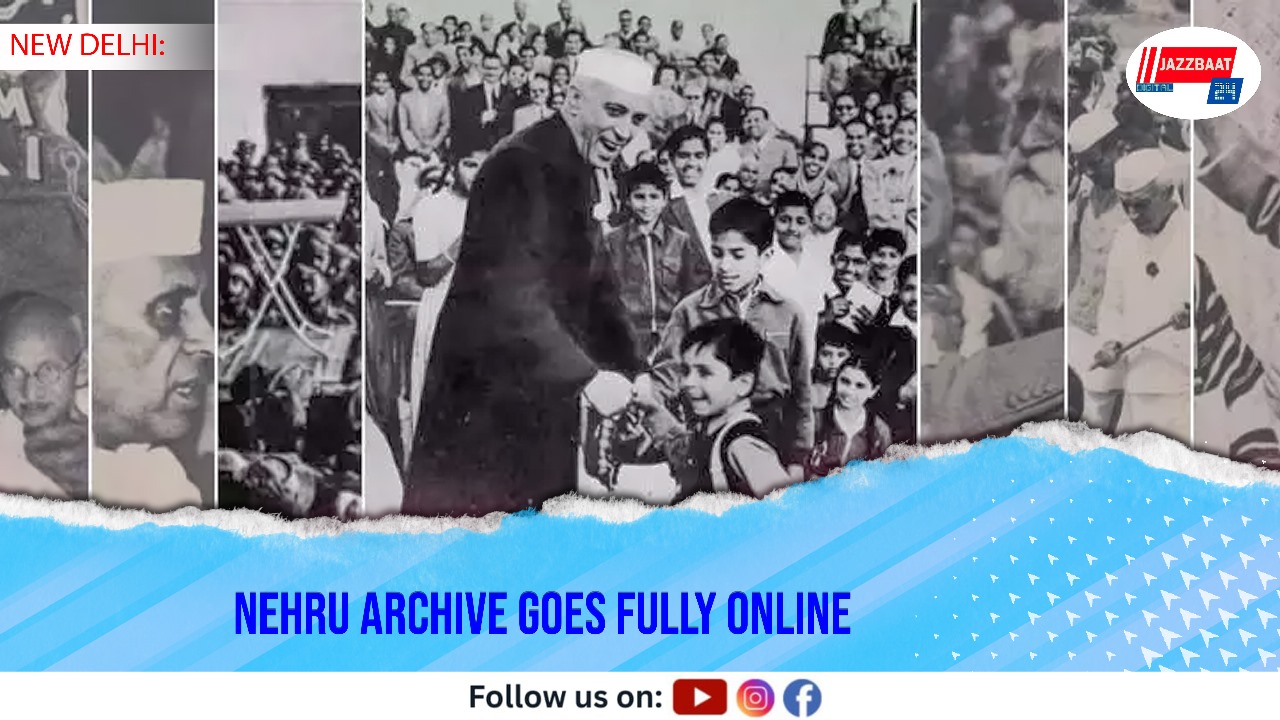
NEW DELHI: India’s first prime minister Jawaharlal Nehru’s writings are now fully available online, Congress leaders said on Friday, marking a major step in preserving the nation’s historical record.
The digitisation of the Selected Works of Jawaharlal Nehru is complete, with all 100 volumes accessible through the new website, The Nehru Archive (nehruarchive.in). The collection contains around 35,000 documents and approximately 3,000 illustrations, including letters, speeches, diary entries, administrative notes, interviews and even doodles. Users can search and download the content freely, both on mobile devices and computers. Congress leader Rahul Gandhi described Nehru’s writings as “not just history, they are a record of India’s evolving conscience.” He added, “For anyone seeking to understand our nation’s democratic journey, its courage, its doubts, its dreams. Hiis words remain a powerful compass.” Gandhi welcomed the archive as a resource that is “open, searchable and free for all,” noting that it will continue to expand over time.
Congress president Mallikarjun Kharge said the digitisation ensures that “facts are facts and will not disappear on account of your likes.” He highlighted the importance of preserving Nehru’s legacy amid what he described as “deliberate distortion, disinformation and misinformation.” The archive was developed by the Jawaharlal Nehru Memorial Fund (JNMF), which said the project drew from 77,000 pages and 35,000 artefacts spanning 61 years. From volume 44 onwards, covering September 1958, speeches are available in both the original Hindi and English translation. Facsimiles of the original print volumes are also provided alongside the digital text.
JNMF trustee and Congress general secretary Jairam Ramesh outlined plans for a second phase to include additional correspondence, including letters exchanged with Winston Churchill and Rabindranath Tagore. He emphasised the value of integrating archives of other prominent leaders of the period such as Sardar Vallabhbhai Patel, B.R. Ambedkar, Mahatma Gandhi and Maulana Abul Kalam Azad.
The online archive is expected to be a vital resource for scholars, students and anyone interested in India’s political and social history from the 1920s to the 1960s.