
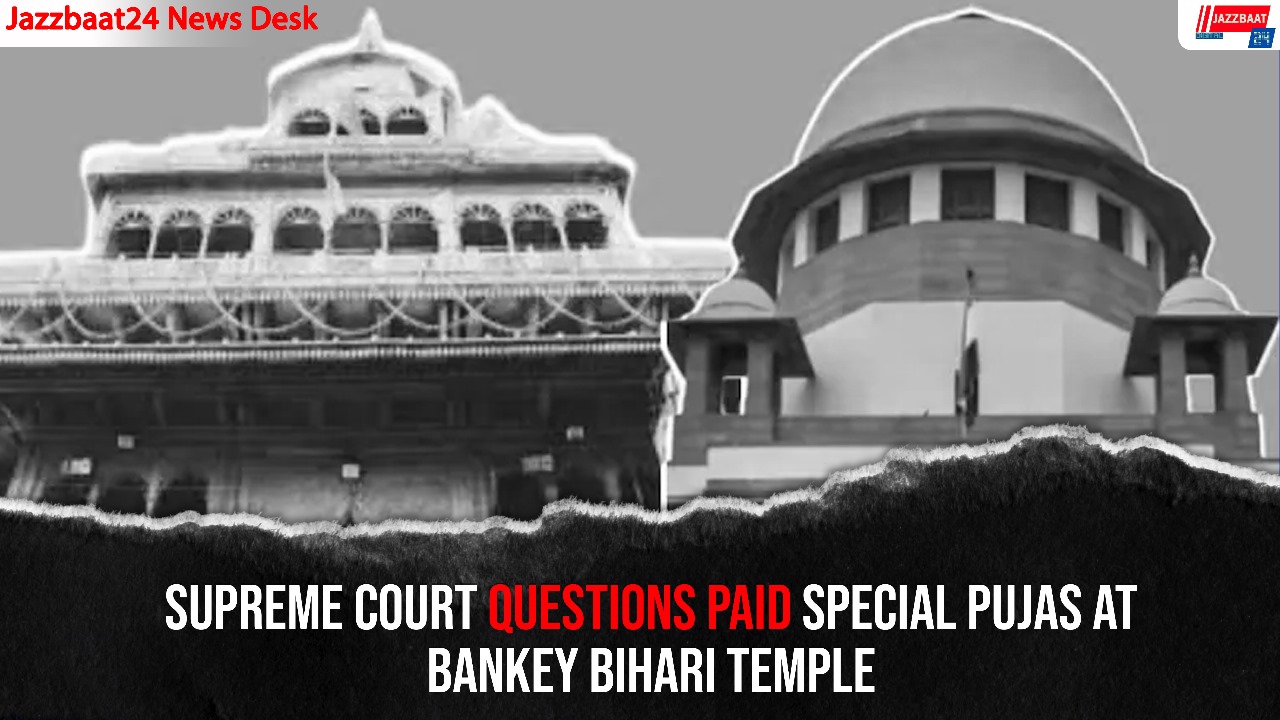
The Supreme Court on Monday expressed strong concern over the practice of allowing paid “special pujas” at temples, observing that such rituals disturb the resting time of the deity and favour affluent devotees. The remarks came during a hearing on a plea challenging recent changes in darshan timings and temple practices at the famous Bankey Bihari Ji Temple in Vrindavan.
A bench led by Chief Justice Surya Kant, along with Justices Joymalya Bagchi and Vipul M Pamcholi, issued notices to the SC-appointed high-powered temple management committee and the Uttar Pradesh government, seeking their response. The matter will be heard again in the first week of January.
Senior advocate Shyam Divan, appearing for the petitioners, argued that the darshan timings are deeply rooted in long-standing traditions and rituals. He said recent changes, introduced through office memoranda issued in September 2025, have disrupted essential religious practices, including the deity’s waking and resting schedule.
The Chief Justice orally observed that after the temple closes at noon, the deity is allegedly not allowed to rest, and instead, special pujas are conducted for those who can afford to pay hefty amounts. “Deities are not allowed to rest,” the court noted, calling the issue extremely important and stressing that sacred timings should be maintained.
The petitioners also objected to the discontinuation of the age-old “Dehri Pooja,” traditionally performed by Goswamis as part of the Guru–Shishya parampara. They argued that the ritual takes place when the temple is closed to the public and does not affect crowd management.
The dispute arises amid broader changes in the temple’s governance. The Uttar Pradesh Shri Bankey Bihari Ji Temple Trust Ordinance, 2025 seeks to replace the 1939 Scheme of Management with a state-controlled trust. While the Supreme Court has stayed the ordinance’s operation, it has appointed a high-powered committee, headed by former Allahabad High Court judge Justice Ashok Kumar, to oversee day-to-day management and ensure basic facilities for devotees.
The court’s observations have reopened debate on balancing tradition, administration, and equality in religious practices.