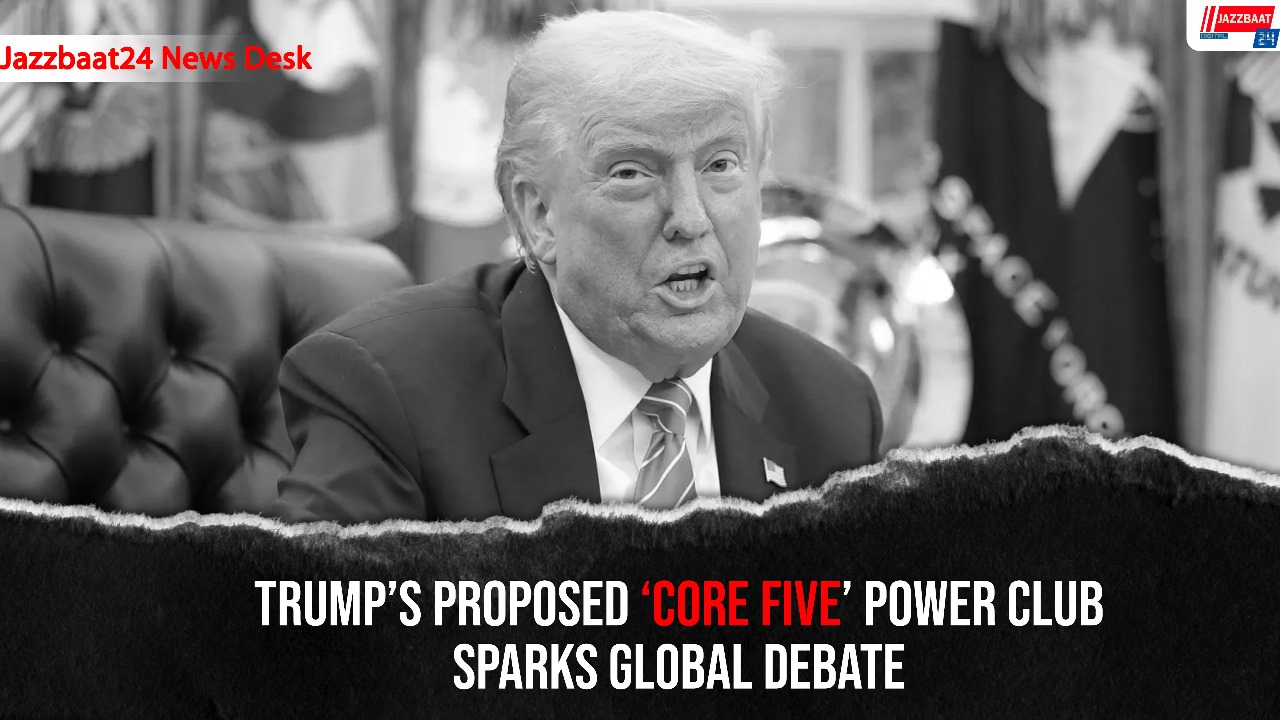
US President Donald Trump is reportedly exploring a new elite global grouping called the “Core Five” (C5) bringing together the United States, India, China, Russia, and Japan. The idea, still unofficial, aims to create a bloc of major population and military-economic powers that would operate outside the traditional wealth- and democracy-based frameworks of the G7.
According to Politico, the concept surfaced in a longer, unpublished version of the National Security Strategy allegedly drafted by the White House. Though the administration has firmly denied the existence of any such extended document, the report first mentioned by Defense One has triggered intense strategic chatter in Washington and beyond.
The proposed C5 would meet regularly like the G7, but with a sharper focus on hard-power issues. Its first suggested agenda point: Middle East security, especially steps towards normalising relations between Saudi Arabia and Israel.
Foreign-policy analysts say the idea aligns closely with Trump’s worldview transactional, personality-driven, and centred around cooperation among major powers with strong regional influence. Experts note that the exclusion of Europe from the C5 indicates a deliberate tilt towards acknowledging Russia as a key global force, possibly distancing the US from Europe-centric alliances.
Former US National Security Council official Torrey Taussig remarked that the proposal reflects Trump’s tendency to favour strong nations capable of exercising regional dominance. Meanwhile, Michael Sobolik, a former aide to Senator Ted Cruz, highlighted that such a grouping marks a dramatic shift from Trump’s first-term approach of strategic competition with China.
The speculation comes amid broader concerns over how Trump’s second administration may reshape global order. Western allies fear that elevating Russia while sidelining Europe could weaken NATO unity and fragment traditional democratic blocs. At the same time, the idea positions India and Japan as key strategic anchors in an emerging multipolar landscape.
While no official confirmation exists, discussions around the C5 underline the shifting priorities and potential realignments defining international politics today.