
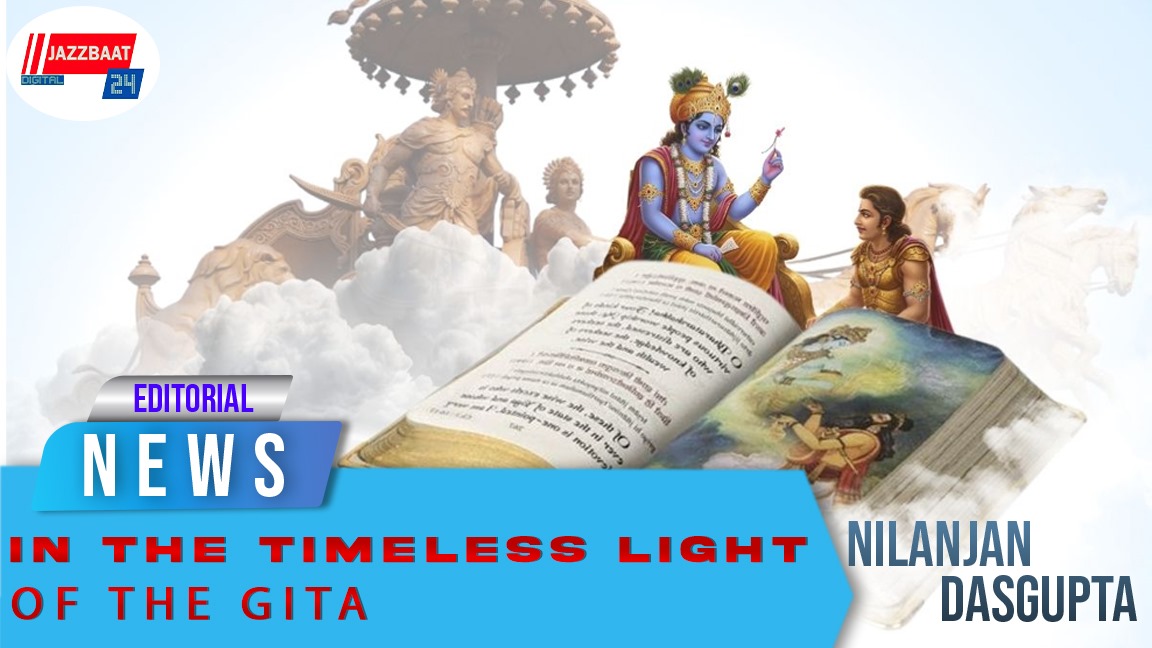
The timeless cadence of the Bhagavad Gita has, for centuries, echoed through the corridors of Indian civilization, illuminating minds clouded by doubt and despair. Today, that ancient resonance returned to Kolkata’s sprawling Brigade Parade Ground, where the sacred verse “Yada yada hi dharmasya…” rose once again not merely as scripture, but as a living, breathing force.
When Lakshya’s voice carried the shloka across the air, the vast gathering fell into a profound stillness. It was as if the city itself paused to listen. In that moment, the chaotic pulse of modern life gave way to an enveloping calm: the kind that descends only when eternal truths are spoken aloud.
At its core, Sanatana Dharma is not ritual it is awakening. The Gita is not just a book; it is a compass of consciousness, a spiritual lodestar for those lost in the fog of inner conflict. In an age fractured by restlessness, intolerance, and exhaustion, today’s public recitation felt like a pure morning breeze drifting into a world long starved of clarity.
As the words “glanir bhavati bharata…” reverberated, the invocation seemed to rise from the collective heart of the nation a plea for the dissolution of moral decay, for the restoration of light. The Gita’s message has always transcended sectarian boundaries. Dharma, in its truest form, is not confinement but expansion justice, truth, compassion, and purification of the self. Today’s event reaffirmed that expansive and humane understanding of the sacred.
Brigade became, for a few fleeting hours, a sacred pavilion of earlier times when listening to the Gita was an act of renewal. In lives increasingly sealed within glass and noise, the virtues it teaches equanimity, patience, introspection are rapidly eroding. The Gita does not promise to calm the storms of the world; it teaches the discipline to still the storm within. And in a city fatigued by daily turbulence, that lesson felt especially urgent.
Another quiet but powerful truth stood out today: the Gita is not a book of division. Its radiance is like sunlight claimable by none, available to all. Political ink has no authority over spiritual fire. The recitation at Brigade was not a rallying cry for factions but a celebration of shared human seeking a moment where citizens turned inward rather than against one another.
Hearing a new generation articulate the verses carries its own significance. Heritage does not survive through monuments it survives through memory, practice, and voice. The young inheriting the Gita’s wisdom signals not nostalgia, but continuity. Amidst cultural churn, the essence of the eternal remains unbroken.
In the end, the Gita is not distant philosophy; it is the mirror in which daily life is meant to be examined. It calls for action without arrogance, duty without desperation, clarity without cruelty. Today, those calls echoed across Brigade with renewed force.
When Dharma rises within hearts rather than from pages, societies transform. The Gita recitation at Brigade may well be remembered as the first tremor of such awakening.
Where the light of Dharma burns bright, humanity prevails and today, that light shone steadily, serenely, unmistakably over Kolkata.