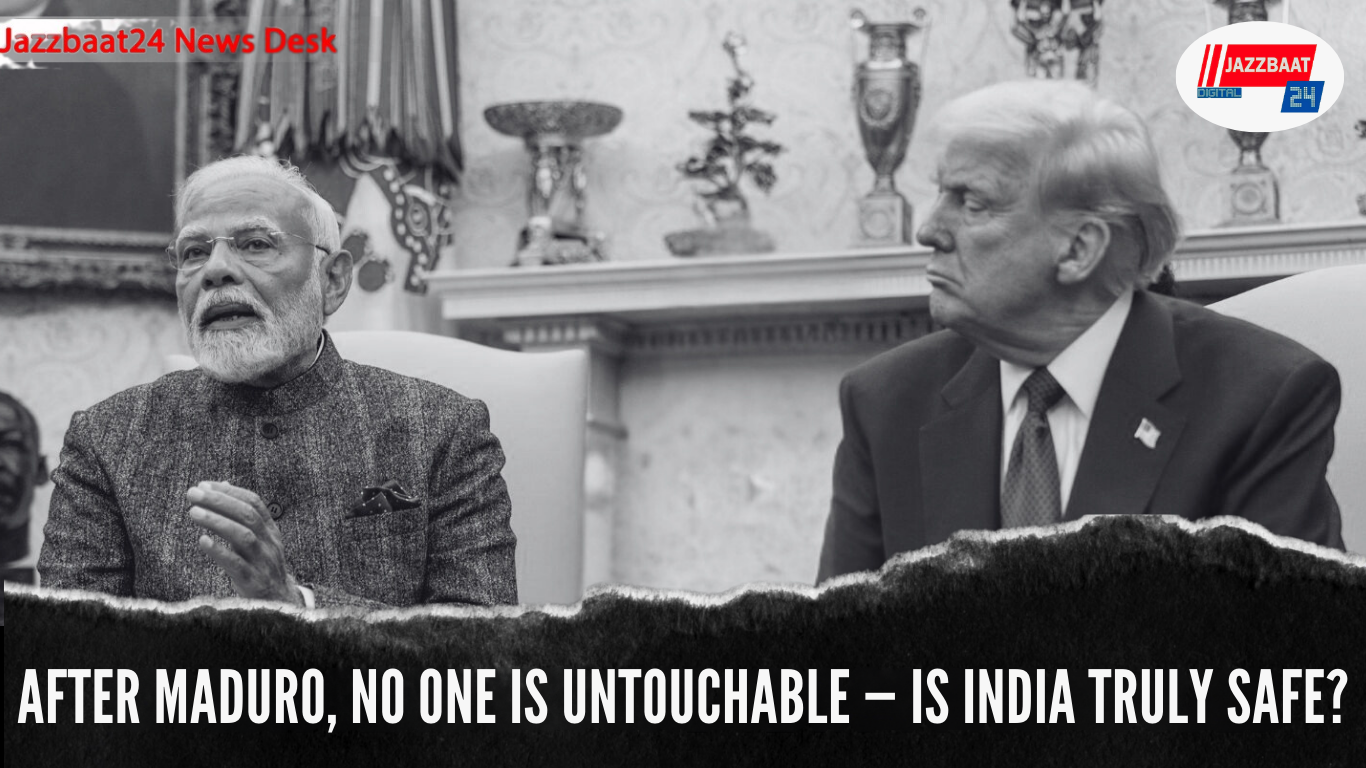
The arrest of Nicolás Maduro was not just a military operation; it was a message. A loud, unmistakable signal that the old rules of global politics are bending, if not breaking. When the United States captured a sitting foreign leader and brought him to American soil, it crossed a psychological red line. Since then, the world has been asking a dangerous question not who is guilty, but who could be next.
President Donald Trump has tried to calm the storm. By ruling out any plan to capture Russia’s Vladimir Putin, he projected restraint. Yet restraint based on convenience is fragile. Putin is protected not by principle, but by power. He commands nuclear weapons, a massive military, and geopolitical leverage. That reality exposes an uncomfortable truth: in today’s world order, safety does not come from legitimacy alone. It comes from strength.
This is where India enters the conversation , not as a target today, but as a thought experiment that should not be ignored. India is often seen as immune, shielded by democracy, population, economy, and strategic partnerships. But the Maduro episode forces a reassessment. If sovereignty can be overridden once, it can be overridden again. The justification can always change human rights, internal instability, strategic necessity, global security. History shows that narratives are flexible when power is absolute.
It would be naïve to assume that friendship with Washington is a permanent insurance policy. Global alliances are transactional, not emotional. Today’s partner can become tomorrow’s pressure point. India’s independent foreign policy, its refusal to be fully aligned with any single power bloc, is both its strength and its vulnerability. In an increasingly polarized world, neutrality itself can be framed as defiance.
The danger does not lie in the likelihood of U.S. troops landing in New Delhi. The danger lies in the normalization of interventionist thinking. Once the idea that a foreign leader can be arrested by another nation becomes acceptable, the threshold of action lowers. What was once unthinkable becomes debatable. What was once illegal becomes “necessary.”
Trump’s America has demonstrated that it is willing to act first and justify later. The Maduro arrest was executed with speed, secrecy, and confidence, signaling that global backlash is no longer a deterrent. This emboldens future decisions, not just by the U.S., but by other powerful nations watching closely. If one can do it, others will feel entitled to try.
For India, the lesson is not fear, but clarity. Safety in the modern world is not guaranteed by size or status. It is earned daily through diplomatic agility, internal stability, economic resilience, and military preparedness. India cannot rely solely on international law or moral arguments, because the global system increasingly respects power over principle.
The world is entering an era where leaders are judged not in courtrooms, but in command rooms. Trump’s refusal to target Putin may sound reassuring, but it also confirms a harsh reality only the powerful are spared. Smaller or strategically isolated nations are expendable. The question is not whether India is safe today, but whether it will always be strong enough to never be questioned tomorrow.
Maduro’s fall is a warning, not an exception. And warnings, when ignored, have a way of returning louder.