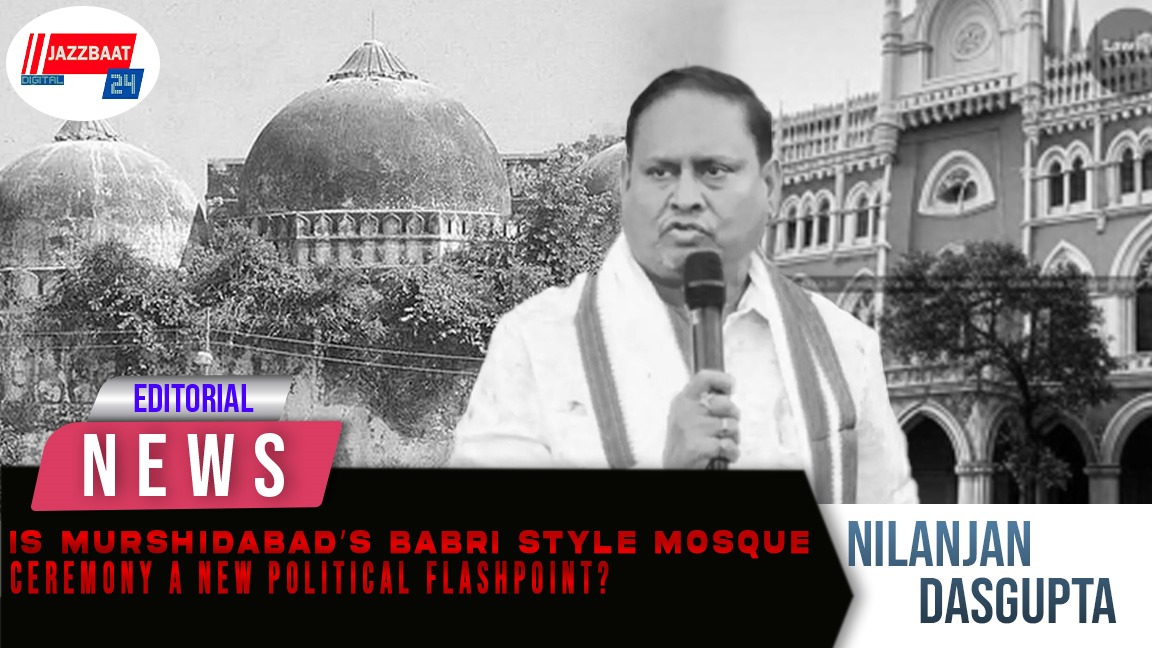
The foundation-laying of a “Babri-style” mosque in Rejinagar, Murshidabad, by suspended Trinamool Congress MLA Humayun Kabir has once again exposed how West Bengal’s political arena thrives on calculated symbolism and reciprocal provocation. The event, held on December 6 the anniversary of the Babri Masjid demolition was more than a religious ceremony. It became a stage upon which two major political forces, the TMC and BJP, appeared to deepen existing communal fault lines while claiming to protect peace.
Kabir, suspended from the TMC earlier in the week for remarks viewed as communally sensitive, went ahead with the ceremony amid chants, clerical presence, and a massive crowd. The timing and style of the mosque’s design inevitably carried political overtones, and the buildup to the event was marked by extraordinary security arrangements. Police, RAF teams, and central forces created a heavy cordon around Rejinagar and neighbouring Beldanga, reflecting official awareness of how volatile the situation could become.
Yet the real theatre unfolded in the political responses surrounding the event. The BJP instantly framed the foundation-laying as part of a larger pattern, suggesting the ruling party in the state had a habit of using sensitive religious symbolism while seeking plausible deniability. Their leaders circulated a proverb “Dhori Machh Naa Chhui Paani” implying that the government’s hands were not as clean as its public stance attempted to suggest. That critique, while sharp, revealed something deeper: Bengal’s politics is increasingly shaped by insinuations and counter-insinuations, where each side attempts to construct narratives that reinforce its electoral strategy.
Questions over the timing of Kabir’s suspension gave further ammunition to the opposition. BJP spokespersons asked why disciplinary action came only after his statements on religious demographics drew attention, and not earlier. This line of argument suggested, without overtly stating, that the state government acts more in anticipation of political backlash than in pursuit of principled governance. In a region like Murshidabad, where religious identities and voting blocs are intricately intertwined, such perceptions can carry significant weight.
Amit Malviya’s intervention escalated the confrontation. His remarks painted the episode as part of a dangerous pattern of political adventurism in a district with long-standing communal sensitivities. The warning about potential implications for NH-12 an essential corridor connecting North Bengal to the rest of the state added a layer of strategic alarm. Whether or not such fears were grounded in immediate threat, their rhetorical use underscored how both sides increasingly treat public anxiety as a political resource.
Kabir’s claim, highlighted by opposition voices that police support would allow construction to continue also became part of the unfolding narrative. While the state administration did not respond publicly to these allegations, the silence itself became a talking point. Critics interpreted the government’s lack of direct engagement as a continuation of its strategy of distancing itself from controversies without addressing the underlying issues.
What the Murshidabad episode reveals is a troubling pattern: symbolic gestures are weaponised, community sentiments are stirred, and governance becomes an afterthought. Neither of the two dominant political forces seems inclined to de-escalate the rhetoric. Instead, they appear locked in a cycle where each side uses the other’s moves to justify its own escalation. The TMC’s disciplinary steps, coming under political pressure, and the BJP’s amplification of communal anxieties illustrate parallel approaches that rely more on spectacle than substance.
Meanwhile, ordinary residents of Rejinagar and its surrounding areas find themselves navigating heightened tensions and heavy police presence. Their everyday concerns employment, infrastructure, security rarely take centre stage in these battles of symbolism. As the state braces for a new phase of political contestation, Murshidabad serves as a reminder that polarisation often begins with gestures presented as harmless ritual, but sharpened into political edges by parties competing for influence.
In the end, the episode is less about a structure’s architectural style and more about the competing forms of political theatre that dominate West Bengal’s public life. The foundation stone laid in Rejinagar symbolises not just a religious project, but the deepening fault lines that both major parties, intentionally or otherwise, continue to widen.