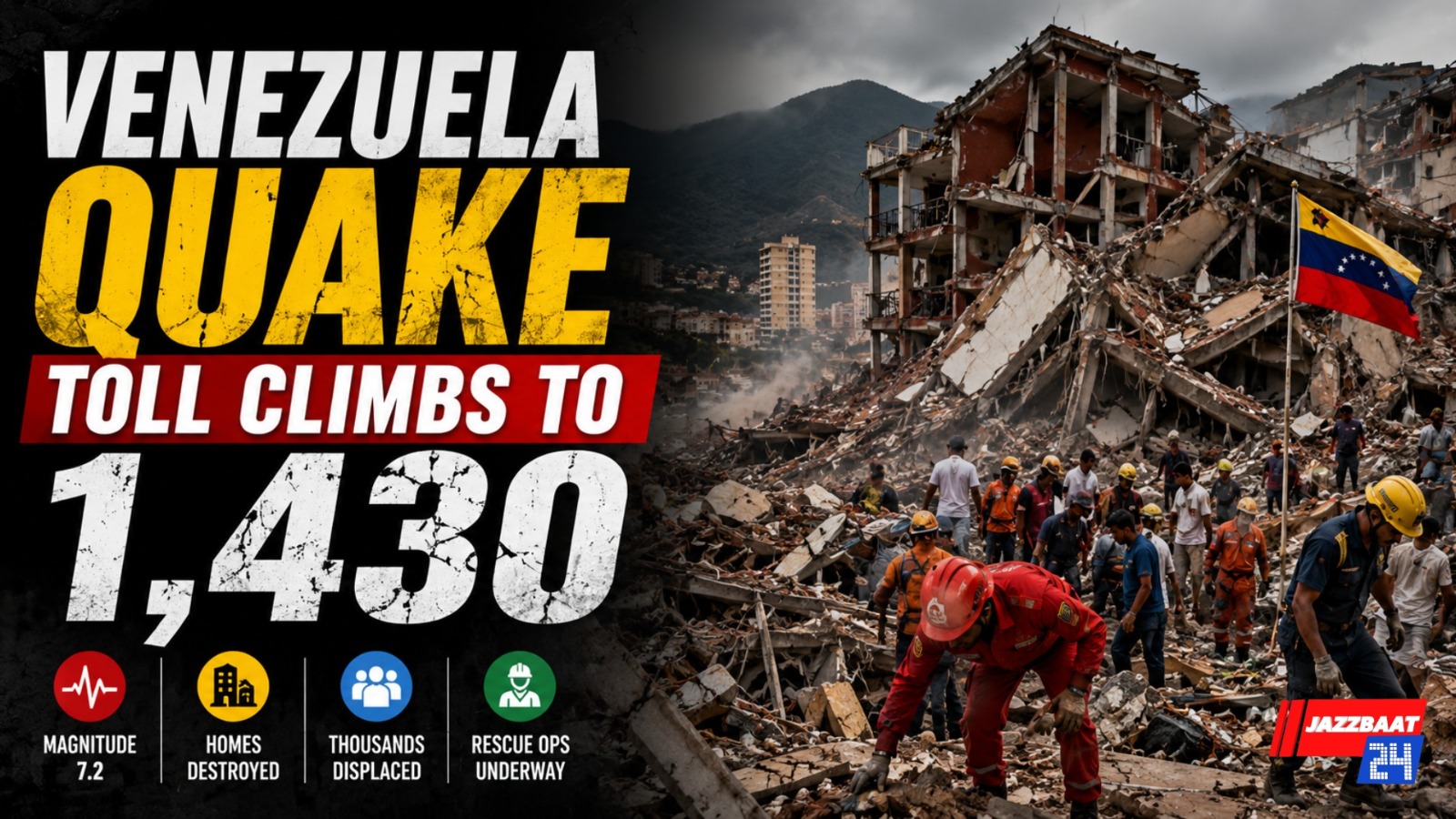
The death toll from Venezuela's devastating twin earthquakes has risen to at least 1,430, while thousands remain injured or missing as rescue workers race against time to find survivors trapped beneath collapsed buildings. Continuous aftershocks, including a fresh 5.6-magnitude tremor on Sunday, have further complicated search and rescue operations across the disaster-hit nation.
The two powerful earthquakes, measuring 7.2 and 7.5 in magnitude, struck Venezuela on Wednesday evening, causing widespread destruction in coastal regions, particularly in La Guaira and parts of Caracas. Authorities say more than 3,200 people have been injured, over 68,000 remain unaccounted for, and thousands have been left homeless.
Rescue efforts have become increasingly difficult due to recurring aftershocks and unstable structures that threaten both survivors and emergency personnel. Many residents have been forced to sleep outdoors, fearing additional building collapses. International aid teams from the United States, Argentina, Mexico, Brazil and several European nations have joined local authorities in the massive rescue operation.
More than 30,000 rescue workers, police officers and military personnel have been deployed to the affected areas, supported by search dogs, medical teams and heavy equipment. Despite the challenges, rescuers have managed to pull several survivors from the rubble, offering moments of hope amid the tragedy.
The disaster has also triggered anger among many residents, who accuse authorities of responding too slowly and leaving communities to begin rescue efforts on their own. In several neighborhoods, volunteers and family members dug through debris with their bare hands before professional rescue teams arrived.
The United Nations estimates the economic damage at around $6.7 billion, equivalent to nearly six percent of Venezuela's gross domestic product. Humanitarian agencies warn that the final death toll could rise further as rescuers continue searching through the wreckage and communication remains disrupted in several areas.
With the critical 72-hour window for finding survivors rapidly closing, rescue teams continue their desperate efforts, even as aftershocks and damaged infrastructure make every operation increasingly dangerous.