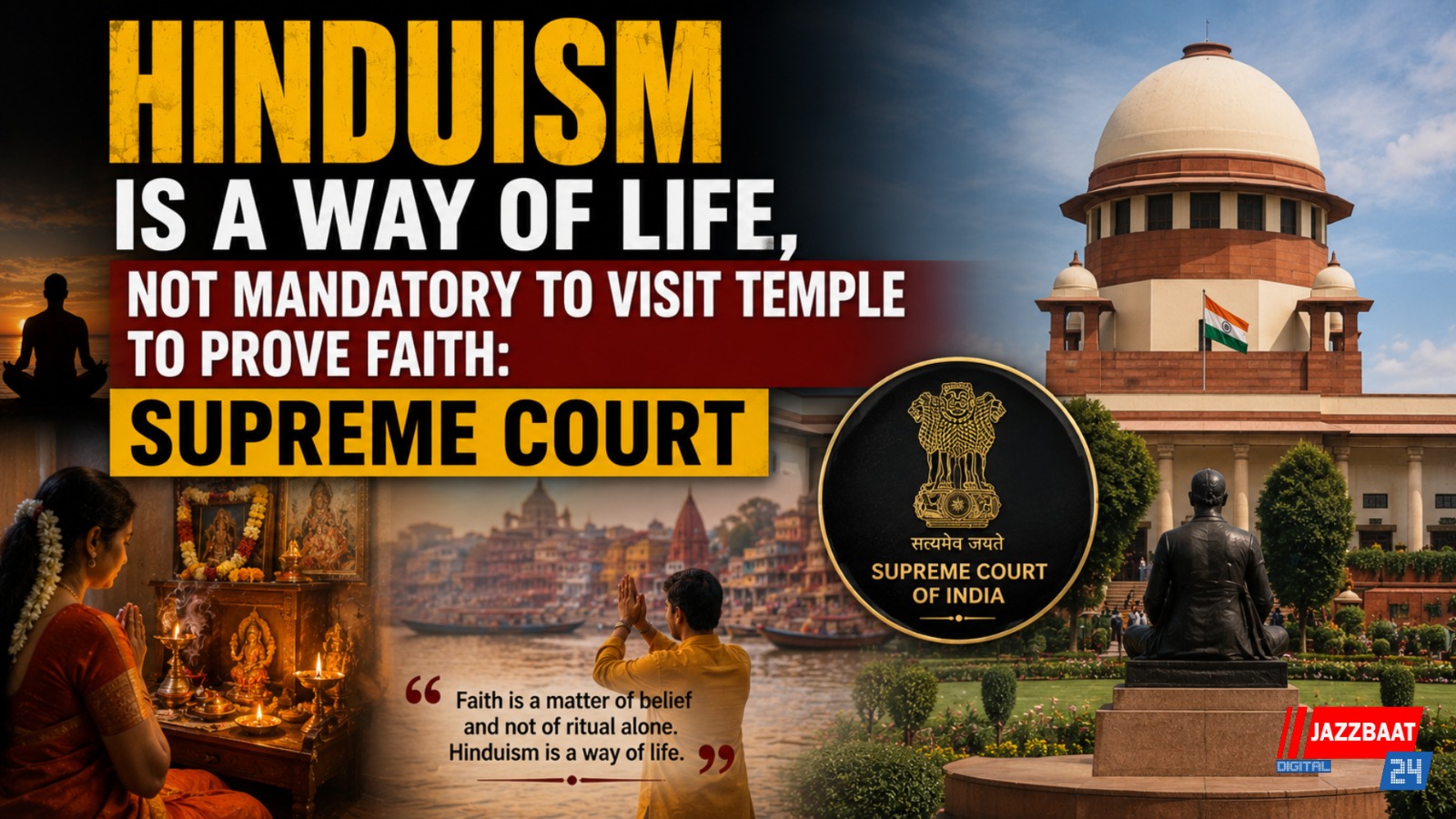
New Delhi: The Supreme Court of India has observed that Hinduism is fundamentally a way of life and not merely confined to rituals or compulsory temple visits, emphasizing that religious belief cannot be measured by outward acts of worship alone.
While hearing a matter related to religious practices and individual rights, the apex court underlined that the essence of faith lies in personal conviction and conduct, rather than mandatory participation in structured rituals. The observation was made in the context of arguments raised about whether visiting temples can be considered a defining requirement to establish one’s religious belief.
The court noted that Indian constitutional principles guarantee freedom of conscience and the right to freely profess, practice, and propagate religion under Article 25. In this context, it reiterated that the interpretation of religion must remain inclusive and flexible, especially in a diverse society where spiritual expression varies widely among individuals.
During the proceedings, the bench highlighted that Hindu philosophy has historically accommodated multiple paths to spirituality, including devotion, knowledge, and selfless action. It pointed out that restricting religious identity to ritualistic practices would be inconsistent with the broader cultural and philosophical traditions associated with Hinduism.
Legal experts say the observation reinforces earlier judicial interpretations that distinguish between essential religious practices and personal choices within faith traditions. The court’s remarks are also seen as part of a continuing effort to balance religious freedom with constitutional morality.
The ruling is expected to have wider implications in cases involving religious rights, social practices, and questions of personal belief versus institutional requirements. However, the court clarified that its observations should not be interpreted as diminishing the importance of places of worship, but rather as reaffirming that faith cannot be reduced to a single outward act.
The judgment has sparked discussion among legal scholars and religious commentators, many of whom see it as an affirmation of India’s pluralistic approach to religion and belief systems. Supporters argue that it strengthens individual freedom of conscience, while critics caution against overgeneralization in interpreting religious customs.
With this observation, the Supreme Court once again emphasized the constitutional vision of India as a secular and inclusive democracy, where faith is ultimately a matter of personal understanding and lived experience rather than compulsory public demonstration.