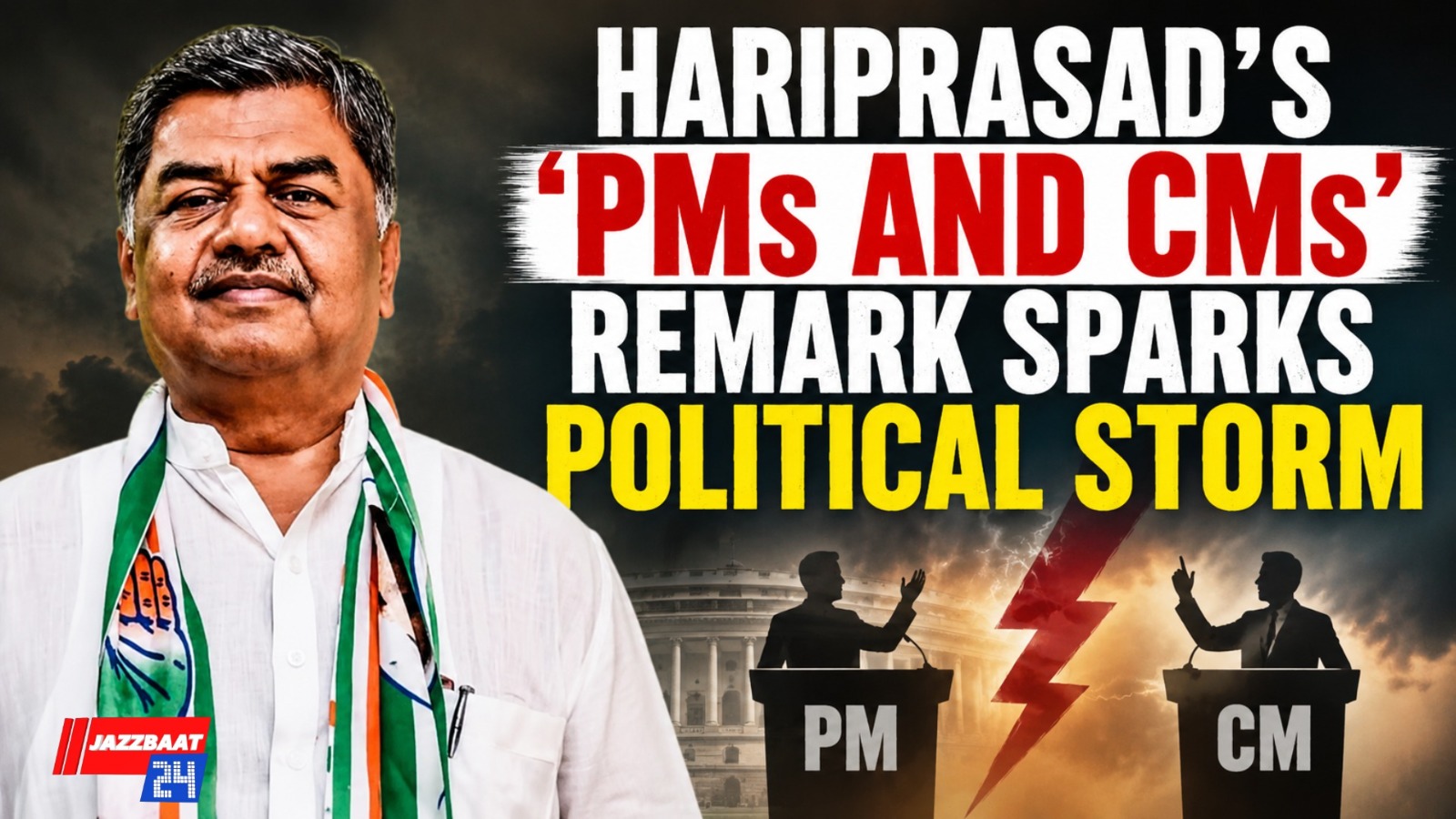
A political controversy has erupted after Karnataka Congress president B. K. Hariprasad said that in today's India, "those who kill cattle go to jail, while those who kill humans become Prime Ministers and chief ministers." The remarks, widely seen as an indirect attack on Prime Minister Narendra Modi and BJP leaders, triggered sharp reactions from the ruling party.
Hariprasad made the comments while addressing Congress workers during the 'Congress with You: Towards Protecting Your Vote' programme in Mysuru, organised to raise awareness about the Election Commission's Special Intensive Revision (SIR) of electoral rolls. During his speech, he drew a comparison between the ideologies of Mahatma Gandhi and Nathuram Godse, saying the country was at a crossroads and people had to choose between the two.
"Today, the situation is such that those who kill cattle go to jail, whereas those who kill humans become Prime Ministers and chief ministers in this country. A true Congressman should not allow this to happen," Hariprasad said during the event.
The Congress leader also accused the Bharatiya Janata Party and the Rashtriya Swayamsevak Sangh of undermining constitutional values and using the voter list revision exercise for political gain. He alleged that the two organisations did not believe in secularism and were attempting to remove certain names from the electoral rolls for electoral advantage.
The BJP hit back strongly, accusing Hariprasad of making irresponsible and divisive statements. Union Minister Pralhad Joshi criticised the Congress leader's remarks and said such comments reflected the opposition party's politics of hatred and attempts to create unnecessary controversy.
The controversy comes at a politically sensitive time, with both the Congress and the BJP intensifying campaigns around electoral issues and voter list revisions in Karnataka. Hariprasad's comments have added another flashpoint to the ongoing war of words between the two parties, with the BJP demanding an apology and the Congress defending its leader's right to raise ideological concerns.