

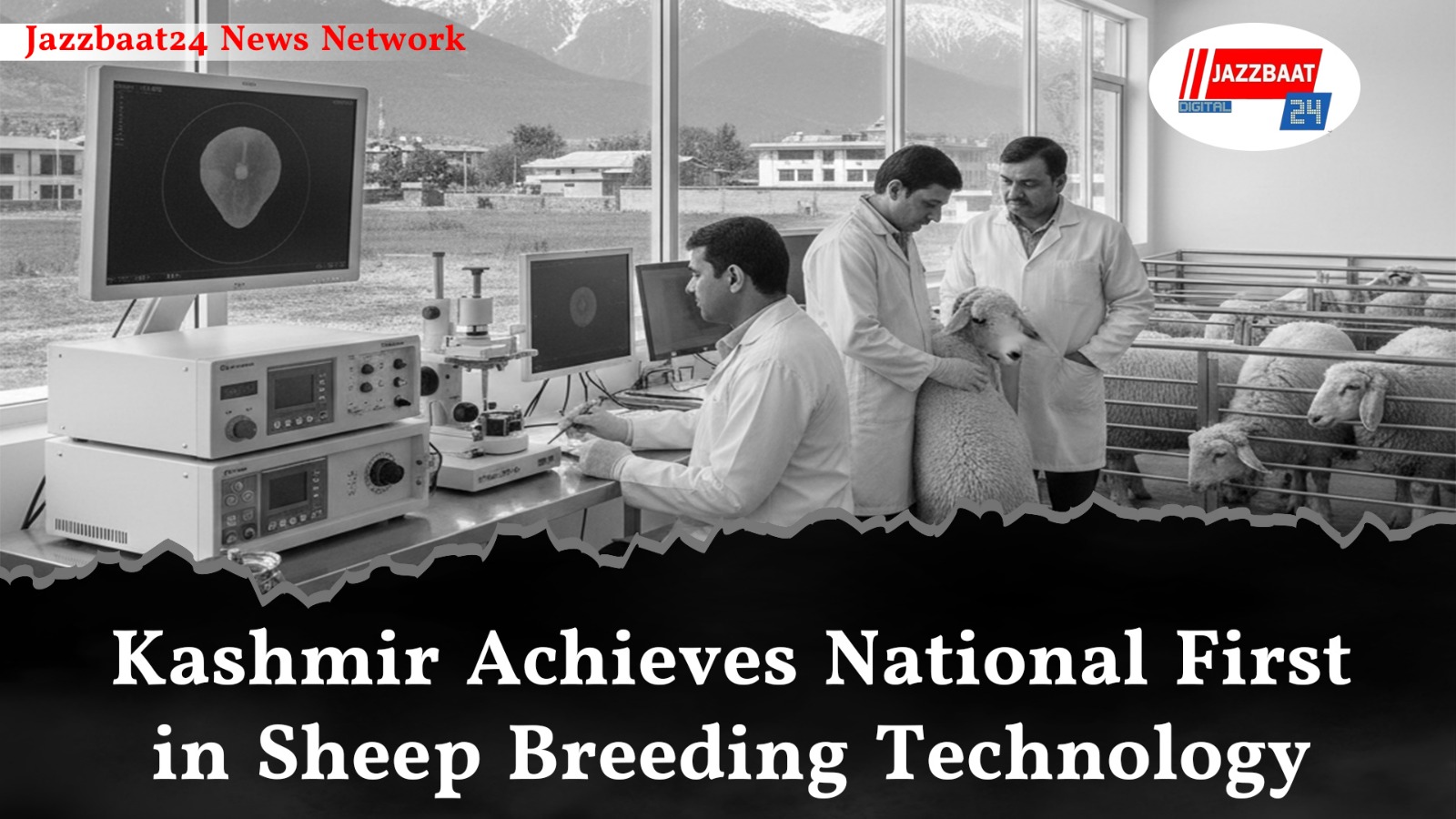
Kashmir has achieved a major breakthrough in livestock biotechnology, becoming the first region in India to successfully apply advanced embryo transfer technology in sheep breeding. The milestone has been achieved by scientists at the Sher‑e‑Kashmir University of Agricultural Sciences and Technology of Kashmir (SKUAST-K), marking an important step forward for the country’s animal husbandry sector.
The research team developed the technique at the university’s animal biotechnology laboratories in Srinagar after years of experimentation and field trials. Embryo transfer technology allows scientists to collect fertilized embryos from genetically superior sheep and implant them into surrogate mothers. This process helps multiply the offspring of high-quality animals much faster than traditional breeding methods.
According to researchers involved in the project, the technology can dramatically improve the genetic quality of sheep breeds in India. Instead of producing only one or two lambs in a breeding cycle, a single superior sheep can contribute embryos that may lead to the birth of dozens of lambs through surrogate mothers. This accelerates the process of breed improvement and helps farmers gain access to stronger, more productive livestock.
The breakthrough is expected to play a key role in addressing the growing demand for meat and wool in the country, particularly in Jammu and Kashmir where sheep farming is a major source of livelihood. Officials say that the technology will help increase both productivity and profitability for farmers by improving meat yield, wool quality and disease resistance in sheep populations.
Scientists at the university have been working on advanced reproductive biotechnology for several years. The institution previously gained recognition for pioneering animal cloning and genetic research in India. More recently, researchers there also created the country’s first gene-edited sheep by modifying the myostatin gene responsible for muscle growth, resulting in animals with significantly higher muscle mass.
Experts believe that combining gene editing with embryo transfer technology could transform sheep breeding programmes across India. By multiplying genetically superior animals quickly, the technology can help strengthen livestock resources and support food security.
Authorities are now planning to expand embryo generation laboratories and related facilities so that the technology can be transferred from research centres to field-level breeding programmes. If implemented on a larger scale, the innovation could help modernise the sheep farming sector and reduce dependence on imported meat while boosting rural incomes.
With this achievement, Kashmir has placed itself at the forefront of animal biotechnology research in India, opening new possibilities for scientific advancement in livestock breeding.