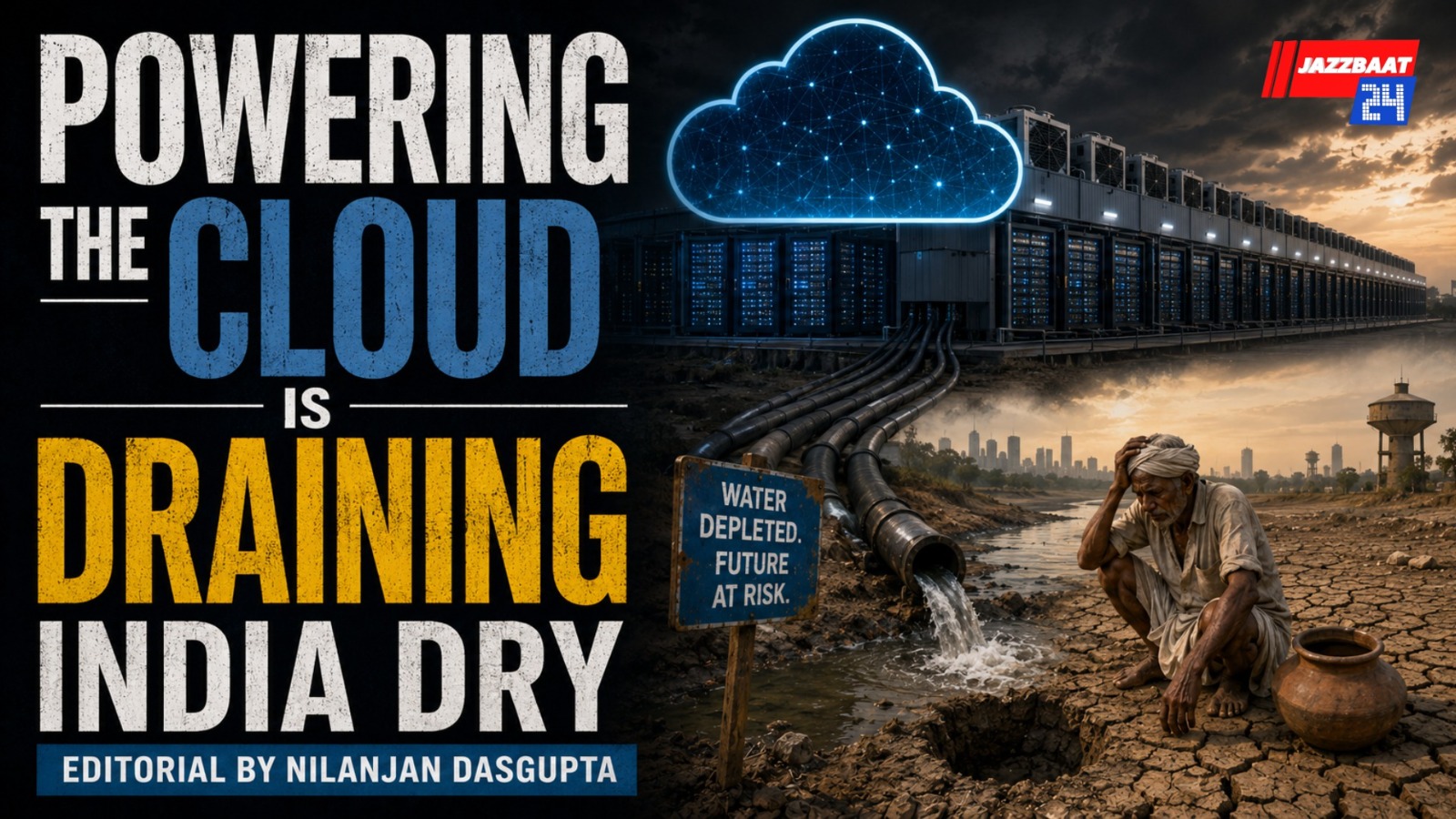
India's rapid push to become a global hub for cloud computing and artificial intelligence is bringing billions of dollars in investment, but it is also raising difficult questions about water security in one of the world's most water-stressed countries. Data centres the backbone of AI, cloud services and digital infrastructure require enormous amounts of electricity and water to keep thousands of servers cool. As demand for AI accelerates, experts warn that India must carefully balance technological growth with its limited natural resources.
India is home to nearly 18% of the world's population but has only about 4% of global freshwater resources. Despite this, global technology companies including Amazon, Microsoft, Google and others are expanding their data-centre footprint across cities such as Mumbai, Chennai, Hyderabad and Bengaluru many of which already experience periodic water shortages. Industry estimates suggest India's data-centre electricity demand could increase nearly fivefold by 2030 as AI adoption grows.
The biggest concern is cooling. Traditional large-scale data centres often rely on water-based cooling systems, and a single large facility can consume millions of litres of water every day under certain operating conditions. Some projections estimate India's data centres could collectively more than double their annual water consumption by the end of the decade if current expansion continues without major efficiency improvements.
However, the picture is more complex than it first appears. Many companies argue that newer Indian facilities increasingly use air-cooled or closed-loop cooling systems that dramatically reduce freshwater consumption. Amazon recently stated that its Indian data centres do not use water for cooling and said its operations in India have become "water positive" through conservation and watershed restoration projects. Microsoft has also introduced next-generation AI data centres designed to minimise operational water use through advanced cooling technologies.
Environmental experts say direct water use is only part of the challenge. The hidden water footprint comes from generating the massive amounts of electricity required to power AI infrastructure. If data centres rely heavily on coal or natural gas, large volumes of water are also consumed in power generation. Researchers argue that India's AI ambitions should therefore be closely linked with renewable-energy expansion, transparent reporting of water consumption and stricter sustainability standards for future data-centre projects.
As India races to become an AI powerhouse, policymakers face a delicate balancing act. Digital infrastructure is expected to create jobs, attract investment and strengthen the economy, but without careful planning it could place additional pressure on already stressed water resources. Experts say the solution is not to stop building data centres, but to ensure they are powered by clean energy, use water-efficient cooling technologies and operate with greater environmental transparency so that India's digital future does not come at the cost of its water security.